

Ekele E. James: The Engineer Who Turned His Laptop into a Free Lab for Africa’s Next DevOps Generation


There is a moment that almost every aspiring DevOps engineer in Africa knows well. You have been watching tutorials, reading documentation, and trying to understand how Kafka handles event streaming or how Kubernetes orchestrates containers. You feel ready to move from theory to practice. Then you open your cloud provider’s pricing page. The numbers stop you cold.
Spinning up a production-like environment on AWS or GCP, the kind you actually need to learn the tools that the world’s biggest engineering teams run on, can generate surprise bills of $200, $300, or more in a single month of exploration. For a developer in Lagos, Nairobi, or Accra, that figure does not just represent money. It represents a barrier. A gate that signals that the most in-demand technical skills of this era are not quite meant for you. Ekele E. James looked at that gate and decided to build a way around it.
The Man Behind the Initiative
James, known in professional circles as a DevOps and Kafka engineer, and by title as a Confluent and Apache Kafka administrator, is not the kind of builder who waits for the ecosystem to catch up with his ideas. His LinkedIn profile reads like the biography of someone who has spent years not just working in technology but thinking hard about what it means to do technology responsibly: improving workflows, implementing cloud security, amplifying feedback loops, and living, by his own account, in a constant state of learning and experimentation.
His professional philosophy has a clarity to it that surfaces almost immediately. “What is worth creating is worth securing,” he has said of his approach, a maxim that reflects both his grounding in cybersecurity and his belief that technical work carries responsibility beyond execution.
He has held positions across DevOps engineering and cloud infrastructure, working with tools like Jenkins, Terraform, Ansible, Docker, Kubernetes, Prometheus, Grafana, AWS, Azure, and GCP. At WesternPride HC Investment Ltd, his disaster recovery work during a serious security breach was credited with preventing what could have been a $30 million loss, earned him recognition from management, and a seat on the organisation’s advisory board after he moved on. The nickname that came with that recognition, “James, the shield,” captured something real about how he operates: with precision, with forethought, and with a clear sense of what is at stake.
But it is not the corporate accolades that define what James is building now. It is the initiative called it L.E.A.P. that he created for everyone who has not yet had those opportunities.
What L.E.A.P Is, and Why It Exists
The L.E.A.P Initiative, which stands for Learn, Execute, Automate, Perfect, is a free, open-source DevOps learning platform that turns any laptop into a production-grade engineering environment. Its premise is deceptively simple: the reason most young engineers struggle to get hands-on with the tools is not that they lack talent or drive. It is that the infrastructure for practising is priced out of reach. LEAP removes that obstacle entirely.
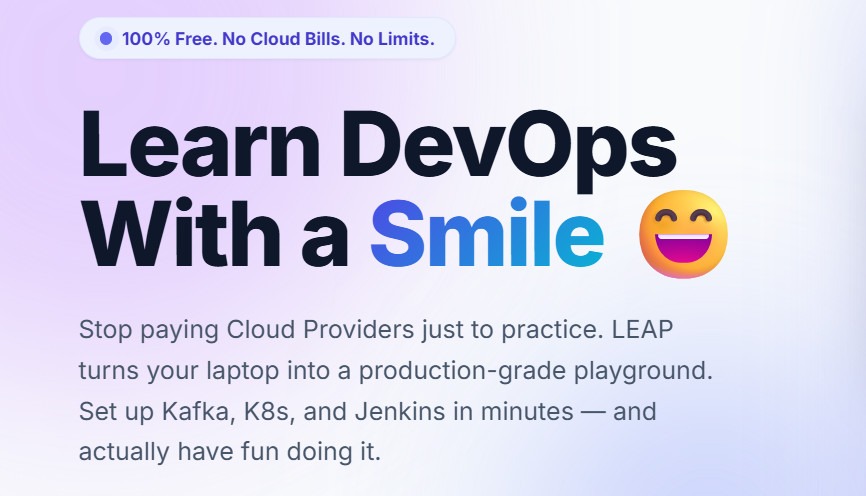
At its core, the platform provides a pre-configured, Docker-based local environment that lets learners spin up real instances of Apache Kafka, Kubernetes, Jenkins, GitLab, PostgreSQL, and Grafana, all running on their own machine, all fully isolated, and all completely free. There is no cloud subscription to manage. No unexpected bill at the end of the month. No ticket to raise when something breaks. That freedom to experiment without financial consequence is, for many learners, the difference between passive watching and genuine mastery.
The setup is built for accessibility. With Docker and Git installed, a user can clone the repository, run a single docker-compose up -d command, and have a fully operational engineering stack running at localhost:3000 in under sixty seconds. The entire stack, which is the same technologies used by world-class engineering teams, is live, connected, and ready to be explored, broken, and rebuilt.
James designed it this way deliberately. The learning that sticks is not the kind that comes from watching a tutorial in safety. It is the kind that comes from breaking a Kafka cluster at 11 PM, diagnosing why the consumers stopped receiving messages, and rebuilding it before midnight. LEAP is engineered for exactly that kind of learning.
A Community, Not Just a Codebase
What makes LEAP more than a clever technical solution is the community that has grown around it. Over 1,000 engineers are now learning on the platform, and the stories they tell are not abstract. They are specific, practical, and human.
Nithya C., a Kafka Engineer at Centene, puts it plainly: she finally understood Kafka because she could break the cluster and rebuild it in five minutes without worrying about cost. Babatunde Adepoju, a DevOps Engineer at Konga Group, used LEAP to prepare for his Certified Kubernetes Administrator exam. Having a real local environment to tinker with, he says, saved his career. Dumebi Idowu, a Product Manager at Aisle, built a full CI/CD pipeline for her portfolio project using LEAP. When she showed interviewers what she had built locally, they were surprised it was all done without cloud infrastructure.
These are not edge cases. They are the recurring patterns of what happens when access to quality learning infrastructure is democratised. Talented people who previously lacked the financial runway to practise at depth now have it. And they are converting that access into real professional outcomes.
The platform’s reach extends well beyond Nigeria. Learners across Africa, India, the United Kingdom, and beyond have found their way to LEAP, which says something important about the universality of the problem it solves. The cloud cost barrier is not a uniquely African challenge. It is a global one. LEAP’s response just happens to have been built from the African context, by a builder who lived the problem firsthand.
What the Tools Actually Teach
To understand why LEAP matters, it helps to understand what it is teaching people to use. DevOps is not a single skill, but an entire philosophy of how modern software is built, delivered, and maintained. The tools that LEAP makes accessible sit at the core of that philosophy.

Apache Kafka, an event streaming platform, powers the real-time data pipelines at some of the world’s largest organisations. Kubernetes, the container orchestration system originally developed at Google, is now the standard infrastructure layer for deploying and scaling applications at the enterprise level. Jenkins and GitLab form the backbone of CI/CD pipelines, the automation systems that allow engineering teams to ship code continuously and reliably. Grafana handles the monitoring and observability layer, giving engineers visibility into how systems are behaving in real time.
These are not niche tools. They are the operating vocabulary of modern engineering. A developer who can speak fluently in all of them is not just employable; they are competitive for some of the most sought-after roles in the global market. LEAP teaches exactly this vocabulary, in a real environment, at zero cost.
The Bigger Picture
Africa’s technology sector faces a well-documented skills gap, not because the continent lacks intelligent people, but because the infrastructure for developing deep technical talent has historically been uneven and expensive. Young engineers have had to choose between learning at the surface level, such as watching, reading, absorbing theory, or finding a way to fund the kind of hands-on practice that turns theoretical knowledge into real competence.
LEAP represents a different model. It is open source, which means it is improvable by the community that uses it. It is free, which means it removes the financial filter that has historically determined who gets to go deep. And it is built around the tools that actually matter in the current job market, which means the skills learners develop on it have immediate, real-world value.
Ekele E. James is not building a certification programme or a bootcamp with a fee structure. He is building an environment and within it, a community where the only things that determine how far you can go are curiosity and persistence. In a continent where those qualities are in no short supply, that is a meaningful thing to build. LEAP’s message to the African engineering community is clear, practical, and entirely without asterisks: your laptop is a data center. Start building.







What a remarkable contribution to the tech community. Empowering engineers to gain hands-on experience without cloud cost barriers will have a lasting impact on the future of tech talent across Africa and beyond.
A cloud bill of $300 ends more African tech careers than any lack of talent ever could. James looked at that wall and built a door. Free, open-source, runs on the laptop you already own. That’s the whole game.