

Two Founders, One Projector: Inside EAP’s Plan to Put a Full School Year in a Bag


A teacher in a Nairobi classroom recently showed Ammar Hamid and Hassan Sheikh what a good picture can do for a lesson. A diagram on the wall held a room of pupils in a way chalk never had. The founders came away with a harder question than whether the lesson worked. How do you get the same lesson to Mandera and Turkana, where the grid flickers and the internet barely exist?
That question runs through everything Education Ambition Possibility (EAP) has built.
A classroom that fits in a bag
The ClassKit is a projector, a battery pack, and a five-button remote. Inside it sits a school year: every lesson for every grade from Grade 1 to Grade 10, across all three terms, mapped to each strand and sub-strand of Kenya’s Competency-Based Education (CBE) curriculum designs. Each lesson has teacher notes and a learning activity. Each slide carries an explanation, vocabulary, an example and a check question.
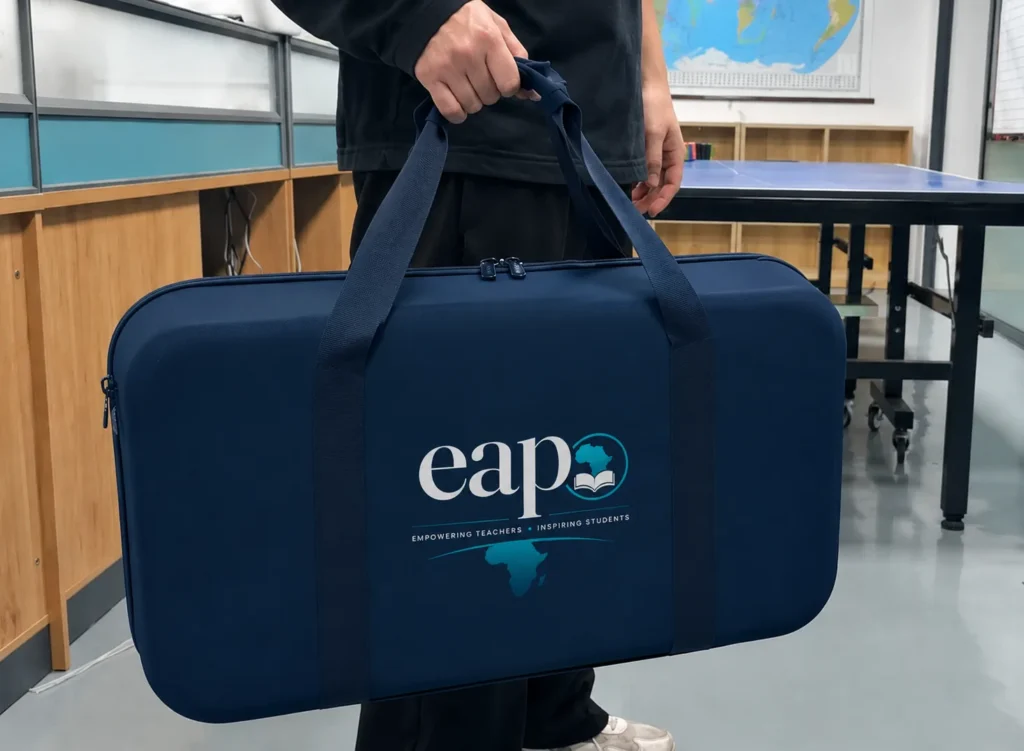
The lesson is the kit. A session runs 40 minutes, a class can have eight a day, and a school running on the ClassKit can project more than five hours of teaching per class, per day. A single battery lasts a full school day. There is no internet to lose and no socket to find.
The design is a reaction to what came before. Earlier education technology programmes tended to need a device for every child, a reliable connection, grid power, weeks of teacher training and a local technician when something broke. The ClassKit needs one unit per class and about five minutes of training. EAP sets up, maintains and replaces the equipment itself, so no school has to find someone to fix it.
The five-button remote came from teachers. Kenyan teachers have taught with chalk for years, Hamid wrote in the Founders’ Log, and their pushback shaped the tool they eventually got, one they could learn in a few minutes. A keyboard has about 80 keys. The remote has five.
The numbers behind the bet
The founders size the opportunity at roughly nine million Kenyan children aged 6 to 15 who have no access to interactive lessons, and up to 350 million across sub-Saharan Africa over the long term. The timing owes a lot to Kenya’s shift to CBE, a curriculum many teachers have had little training to deliver. A library of ready-to-teach lessons arrives at the moment schools need one.
The early evidence is modest and specific. EAP piloted the kit in a Kenyan school across three classrooms, seven teachers and 90 students, with full school days of use over two weeks. “It took me five minutes to know how to use it,” one pilot teacher said. The company now works with seven schools and 114 classrooms, and every one of them arrived through a referral from an education leader rather than cold outreach.
In Mandera, in northern Kenya, Hamid and Sheikh took the kit to two schools alongside regional partner RACIDA. Teachers and education officials responded warmly, Hamid reported afterwards. No learning-outcome data has been published yet, and that is the figure schools and funders will eventually ask for.
There is also a dependency built into the model. Once a school’s timetable runs on the ClassKit, taking it out means re-planning the whole year. That stickiness works in EAP’s favour as a business and raises the stakes for schools that adopt it.
Two founders, split down the middle

Hamid, the CEO, leads product and sales. He built the platform end to end, from the offline ClassKit app to the school learning management system, and brings 11 years in product and business. He spends much of his time in Kenyan classrooms with teachers and school leaders.

Sheikh, the COO, runs operations and delivery. He co-built the platform and owns testing, device setup, licensing and deployment. Before EAP he spent nine years in digital transformation at the UK’s National Health Service, rolling out software across hospitals. The work taught him how technology fails in large institutions, and he has written about carrying those lessons into Kenyan classrooms.
It is a familiar split for a hardware-led company: one founder close to the customer and the product, the other responsible for making sure devices arrive, work and keep working. The two write together in the Founders’ Log about decisions, partnerships, negotiation and the realities of building a company in Kenya and Africa.
A planned entry on what they look for in a co-founder suggests the openness will continue. What they haven’t yet published is a single origin story explaining why they started EAP, and the entries so far describe how they work more than what first set them on this path.
Beyond Kenya
Kenya is the first market, and the founders are clear it is not the last. Cheaper projectors, batteries and storage now make it practical to put a school year on a single device, and the hardware itself is curriculum-neutral. Any national syllabus can run on it. Only the lessons change.
That last part is where the real work lies. A Ugandan, Tanzanian or Ghanaian version would need its own library, mapped to that country’s curriculum and, in the early grades, taught in the language children actually speak at home. The hardware approach suits the places where it matters most: weak grids, costly data and classrooms too crowded for a tablet per child.
The buyer changes from country to country as well. In some markets it will be a ministry or county authority, in others an NGO, a donor-funded programme or a private school network. EAP already has a section of its site for NGOs and charities, an early sign of where it expects some demand to come from. Whether the model scales profitably will depend on what it costs to deliver and maintain devices across long distances, since EAP carries that responsibility itself.
How to connect with EAP
Schools, NGOs, funders and investors can request a demonstration on the EAP website, or write to [email protected]. The founders welcome conversations with educators, engineers and operators who want to improve learning in Kenyan classrooms, and with schools that want to see a lesson in action. Both founders can be reached through the LinkedIn links on the team page, and the Founders’ Log offers email updates for new entries.
EAP is a trading name of EAP Technology Limited, which is registered in England and Wales and in Kenya.
What comes next
EAP has a defined product, a growing base of schools and two founders whose responsibilities don’t overlap. The questions ahead are practical. Do pupils learn more with the kit? Do the economics hold when it moves from referral-led schools to remote counties? Can the model carry over to another country’s curriculum? The next few hundred classrooms will begin to answer them.