
Jara Pascual: The Engineer Who Decided Innovation Should Never Be a Solo Journey


There is a particular kind of frustration that only innovation managers understand, the kind that comes from knowing exactly what your company needs to move forward, but having no reliable way to find the right people to make it happen. For Jara Pascual, that frustration did not stay on a spreadsheet; it became a company.
Today, Pascual is the founder and CEO of Collabwith, an online platform built to connect businesses, universities, researchers, and startups in structured, purposeful collaboration. She is also a published author, a podcast host, a board member who speaks at the European Parliament, and one of the more distinctive voices in the global innovation ecosystem. But before any of that, she was a Telecom Engineering student in Spain, sitting in a classroom that would change everything.
An Engineer Who Found Her Purpose in Society
Pascual did not always know what she wanted to build. She knew she wanted to invent things. But the television had already been invented, as she likes to say. What she found instead was something arguably more interesting: the intersection between technology and society.
It was an elective class, “Science, Technology, and Society,” taught at the university by professors José B. Mariño and Climent Nadeu, that first showed her this territory. She started reading Manuel Castells on how technology reshapes the world, and something clicked. Later, research on user experience and human-machine interaction with Professor Raquel Navarro-Prieto completed the picture. The pieces came together around a single idea: innovation that puts people at the center.
She went on to earn a Master’s in Telecommunication Engineering, then an MBA in the Netherlands, where she moved specifically to prepare herself to run a business. By that point, her path was set. But the clarity came from lived experience and not by theory.
The Adidas Years and the Spreadsheet Nobody Should Have to Build
Before founding Collabwith, Pascual spent years working as an Innovation Manager inside some of the world’s largest companies, including the Adidas Group, where her team won awards from SAP for service delivery. She was good at her job. But she kept running into the same wall.
Her role required building research collaborations with universities and startup partners, who could help drive genuine innovation rather than incremental change. The problem was that no easy infrastructure existed to do this. She found herself building a manual spreadsheet, listing universities, academics, and their research projects relevant to her areas of responsibility. It was painstaking work done on top of everything else, and when she finally reached out to the academics she had catalogued, many simply did not respond. When they did, the process that followed was long legal negotiations, meetings that went nowhere, projects that ended as thin shadows of their original ambitions.
That experience, compounded by similar frustrations across years of working in Fortune 500 companies and R&D labs, became the raw material for Collabwith. She had seen the problem from the inside. Now she wanted to build the solution.
Building the Platform She Wished Had Existed
Collabwith launched as what Pascual describes as an “all-in-one place” to find, request, and contract with academics and startups faster, in a standardized way, and without the friction that had characterized her years as an innovation manager. The idea was not simply to create a database or a directory, but to structure the entire experience of collaboration so that both sides, the businesses and the researchers or innovators, could engage with genuine clarity about what they each needed and offered.
Over time, the platform evolved. It now functions as a full innovation ecosystem tool: a marketplace where companies can access European funding programs, scientific publications, EU tenders, patents, and past and present EU projects. It includes a digital academy called Collabmindset, designed to give teams and employees the mindset to think about innovation rather than just execute tasks. There are programs for ecosystem coordinators, for companies trying to build innovation cultures, and for consultants who want to become what Collabwith calls “Collab Brokers.”
The methodology underpinning all of it is Pascual’s own, a framework she developed through years of observation, active listening, and user-centered design. She has packaged it into what she calls Collaboration Canvases: practical, one-page tools that help teams make their needs and expectations explicit before a partnership begins. There is a Collaboration Canvas, a Collaboration Plan Canvas, a Business Plan Canvas, and an Innovation Ecosystem Canvas. Each one grew out of a specific problem she saw organizations failing to address.
The Book, the Podcast, and the Parliament
In 2021, Pascual published “Innovation and Collaboration in the Digital Era” through De Gruyter, one of the world’s oldest academic publishers. The book draws on 34 interviews with politicians, innovation leaders, academics, and entrepreneurs, and makes a case that emotional intelligence, not just strategic thinking, is central to effective innovation leadership. The Emotional Intelligence angle was deliberate; Pascual had seen enough failed collaborations to understand that feelings of frustration, misaligned expectations, and unspoken needs were often what derailed otherwise promising partnerships.
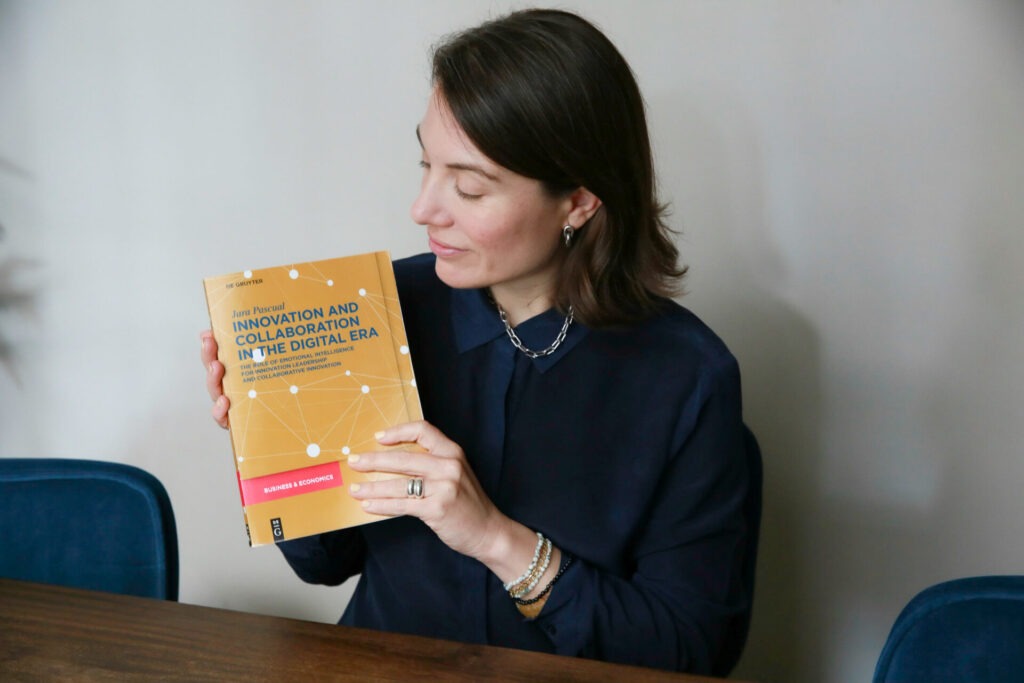
The book drew praise from, among others, a research affiliate at the Yale Center for Emotional Intelligence and the CIO of New York Mellon Bank, a range of endorsements that reflects the cross-sector audience Pascual has built.
Her podcast, “Business of Collaboration,” has been running alongside the platform and the book, featuring conversations with researchers, practitioners, and innovation leaders from across the world. It functions partly as a content engine and partly as an ongoing research project: Pascual has always treated conversations as data, and the podcast gives her a structured way to gather it.
Her voice has also been heard at the European Parliament, where she sits as a board member of the Forum Knowledge4Innovation. In that capacity, she has spoken on topics including female investment, digitalization, and the critical question of how to move research from the lab to the market, a challenge she understands from both sides.
Why Collaboration Is a Feminist Issue
Pascual does not shy away from connecting innovation to gender. She has spoken at the European Parliament’s Committee on Women’s Rights and Gender Equality, making the point that the innovation ecosystem loses perspective when half the population is structurally underrepresented in it. Her work at Collabwith includes a dedicated focus on gender and diversity, not as a social media talking point, but as a genuine design principle.
Her argument is straightforward: if the people building and funding innovation look the same, think the same, and share the same experiences, the solutions they produce will inevitably have blind spots. Fixing that requires more than representation on panels. It requires changing who holds decision-making power, who gets funded, and who is treated as a credible source of ideas.
A Platform for Ecosystems, Not Just Individuals
What sets Collabwith apart from a typical networking tool is its focus on ecosystems rather than individuals. Pascual built it for the people who manage innovation for organizations, the ecosystem coordinators, the R&D leads, and the people whose job it is to look outside their walls and find what they cannot build alone. It is, in many ways, a platform for people like her former self.
The SaaS side of the business now includes a white-label option, meaning other organizations can offer the platform under their own brand. Collabwith also runs structured programs for companies trying to build innovation cultures, for teachers who want to integrate its methodology into their courses, and for professionals who want to help others collaborate more effectively.
Jara Pascual started with a frustrating spreadsheet and a clear sense that the world of innovation needed better infrastructure. What she built is a company, a methodology, a book, and a platform that has made that vision real and keeps making it more so, one collaboration at a time.
Jara Pascual is the founder and CEO of Collabwith. Learn more at collabwith.com or follow her work via the Business of Collaboration podcast.