
Meta Wants Its AI to Run Your Business Dashboard. Here’s What That Actually Means

Meta has begun rolling out a significant upgrade to Meta AI, one that turns the assistant from a general-purpose chatbot into something closer to a plugged-in business analyst. Announced this week, the update lets small business owners connect Meta AI directly to their Facebook and Instagram accounts, their Meta ad campaigns, and their Google Workspace tools — Gmail, Docs, Sheets and Slides — so the assistant can read actual account data rather than guess at it (Meta).
The feature is live across meta.ai, the Meta AI mobile app, and a new Meta AI desktop app for Mac, which adds screen-sharing during a session and built-in dictation. For small business owners who typically double as their own marketing department, bookkeeper and customer service line, the pitch is straightforward: hand Meta AI the login details, and it hands back the kind of analysis that used to require a paid analyst or a stack of exported spreadsheets.
What the assistant can actually do
Once connected, Meta AI can review organic Facebook and Instagram performance — reach, saves, shares, comments, profile visits — and tell an owner which posts are working and why, then package that into a report on a recurring schedule rather than a one-off answer. A business owner could, for instance, ask what content performed best over the past month and request the same breakdown delivered automatically every Monday.
It can also pull in Meta ad data to flag which audiences are converting, which creative has gone stale, and where budget might be better spent, then turn that analysis into something presentable, such as a short slide deck for a team meeting. Instead of stopping at a recommendation, the tool is designed to produce the material needed to act on it.
A third capability sets this update apart from a standard analytics dashboard: Meta AI can look at public content from comparable brands on Facebook and Instagram and use it for competitive benchmarking. An owner can ask how their page compares with five similar businesses and get a breakdown of what’s driving the gap — a form of analysis that has historically sat behind paid tools like Sprout Social or the higher tiers of Hootsuite’s analytics suite.
The features are free to start. Meta has said deeper functionality will eventually sit behind a Meta One subscription, though it hasn’t detailed pricing or which capabilities move behind the paywall.
Early feedback and the trade-off it points to
Meta shared testimonials from small businesses that trialled the features ahead of launch, and the recurring theme was specificity. Where generic AI tools tend to produce advice that could apply to any business, testers said Meta AI’s output referenced their actual ad performance, their actual client style, their actual content history — because it was drawing on that data directly rather than working from a prompt alone.
That specificity is also the trade-off worth naming. To get advice this tailored, a business has to hand an AI assistant read access to its ad spend, its audience engagement patterns, and potentially its Gmail and Google Docs. For a solo operator or a two-person team, that is a meaningfully different decision than it is for a company with a compliance function reviewing the request. Meta’s announcement doesn’t dwell on data handling, retention, or what happens to connected account information if a business later disconnects — details that matter more the smaller and more exposed the business is.
Where the value actually sits
None of this means the update is a marginal one. The recurring-report function solves a genuinely common problem: analysis that owners know they should be running regularly but rarely get around to, because it competes with the dozen other roles a small business owner fills in a given week. And competitive benchmarking against named comparable brands, built into a tool that’s free to start, is not something most small businesses have had easy, direct access to before — it typically required either a paid subscription or a marketing agency doing the legwork manually.
The more useful question for any small business owner weighing whether to connect their accounts isn’t whether Meta AI works as advertised. Early tester feedback, and the underlying mechanics of the update, suggest it largely does what Meta says it does. The real question is whether a given business already produces enough of a digital footprint — consistent posting history, an active ad account, a reasonable stretch of engagement data — for the assistant to say something the owner doesn’t already know. A business with a thin or irregular presence on Facebook and Instagram will get thinner, less useful output than one that’s been posting and advertising consistently for months, simply because there’s less signal for the AI to work with.
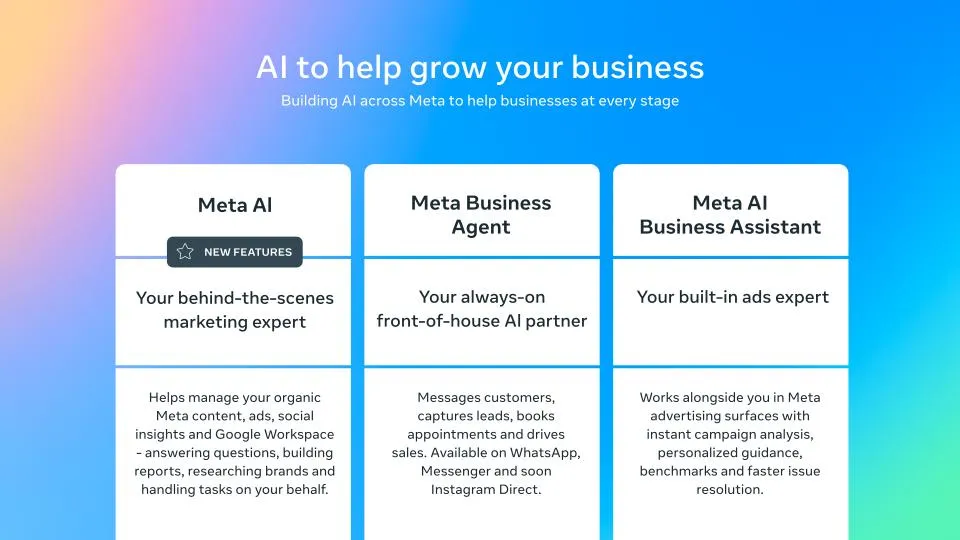
Meta has described this as the first phase of a broader push, with more integrations and capabilities expected in the coming months. The company is also building out adjacent tools — a Meta Business Agent aimed at automating customer conversations, and a Meta AI business assistant positioned as a lighter-touch entry point — suggesting a longer-term strategy of embedding AI at every stage of how a small business operates on its platforms, not just in the analytics layer. For now, the immediate opportunity is narrower but real: businesses with an established presence on Meta’s platforms have a free, reasonably capable analyst available inside a tool they’re likely already using.
More details of this can be found on Meta’s blog here.