
At 17, He’s Helping Lagos Motorists Find Fuel Before They Waste a Trip

Olisa Odukwe was 11 when his family moved from Lagos to Dubai. Six years later, in his final year of school and thousands of kilometers from home, he is still building for the city he left, running a WhatsApp-based service that helps Lagos motorists check petrol prices, availability and queue lengths before they set out to fill up.
The platform, fuelnaija, has grown to more than 7,000 monthly active users and over 10,000 verified reports as of September 2026, with contributors submitting information from all 20 local government areas in Lagos. It recently earned Odukwe a spot on the Top 45 selection for the Nigeria Innovation Summit 2026 Award, an event that has drawn more than 15,000 delegates across its previous editions.
A problem shaped by growing up in Lagos
The idea behind fuelnaija traces back to the kind of everyday uncertainty Odukwe grew up navigating in Lagos, where an unpredictable commute or an unexpected fuel search could upend a day’s plans. That uncertainty, and the instinct Lagosians already had for helping each other work around it, became the starting point for the platform.
Nigeria’s fuel supply problems are not new, and neither is the informal, word-of-mouth network motorists have long relied on to figure out which filling station actually has product, at what price, and how long the queue will be. Odukwe’s contribution was to take that existing local knowledge and give it a wider reach: a structured, shareable version of the same information Lagos residents were already passing along to each other, just faster and available to more people at once.
Despite living in Dubai, he has kept that connection to Nigeria active by building, in his words through the press materials describing his work, a service he wants to be genuinely useful at home. Alongside his final year of school, he develops the product, reviews incoming reports and coordinates the contributors who keep the platform running, all in the time he can carve out around his studies.
How it works
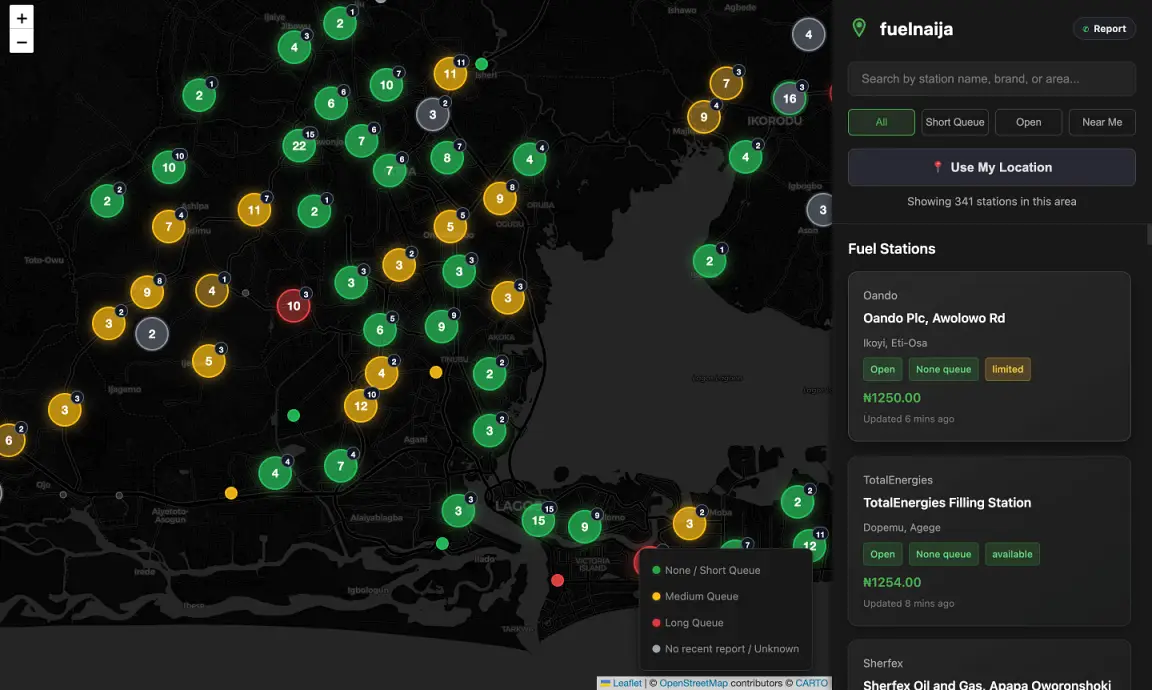
fuelnaija’s design leans on a tool motorists already know how to use. Rather than asking people to download and learn a new app, the service runs primarily through WhatsApp: motorists can request information on nearby filling stations directly through a chat, or turn to a public map for the same data in a more visual form.
Contributors submit the station name, the petrol price, whether the station is currently operating, fuel availability and queue length. Those reports then go through a validation and moderation process designed to catch incomplete, duplicate or implausible submissions before they reach other users. Reports are time-stamped and tied to specific stations, though the platform is upfront about the limits of that data: conditions at a filling station can change after a report has been filed, which is simply the nature of real-time, crowd-sourced information.
The public map itself, built on the WhatsApp Cloud API, Cloudflare Workers and a web-based station interface, lets users filter stations by whether they are open, have short queues, or are simply the closest option, all pulled from the same pool of community-submitted reports that power the WhatsApp side of the service.
An unusual academic path behind the product
Odukwe’s approach to building fuelnaija has been shaped as much by his academic experiences abroad as by his memories of Lagos. As an alumnus of Yale Young Global Scholars, he studied politics, law and economics alongside students from a range of countries, an experience that broadened his sense of how development challenges look different depending on where you are standing, and reinforced the importance of listening to people whose day-to-day realities differ from his own. That outlook feeds directly into how he thinks about fuelnaija: a service built for Nigeria, he has said, has to fit how people there actually live, communicate and make decisions, not how a product built somewhere else assumes they should.
His research work adds another layer. Through the Cambridge Centre for International Research, Odukwe studied how markets reacted to US Federal Reserve announcements, testing his results against 5,000 simulated calendars, and presented his findings at the CCIR symposium at King’s College, Cambridge. The exercise trained him to separate meaningful patterns from statistical noise, a skill he now applies closer to home in a more practical setting: assessing how reliable fuelnaija’s crowd-sourced reports really are before they’re surfaced to other users.
What’s next
For now, fuelnaija’s footprint is Lagos-specific, drawing on reports from residents across all 20 of the city’s local government areas. Odukwe’s ambitions extend past the city, though: he wants the platform to eventually reach other Nigerian cities facing similar fuel-access uncertainty.
What ties the whole project together is Odukwe’s stated intention to bring the skills he’s developing abroad, from international policy discussions in Yale’s program to statistical research at Cambridge, back to bear on problems at home. For a service built on local knowledge and community trust, that combination of outside training and inside understanding of Lagos may be exactly what keeps fuelnaija credible with the motorists who depend on it.
fuelnaija is available via WhatsApp and at fuelnaija.com. For interviews, product demonstrations, or additional data, Olisa Odukwe can be reached at [email protected].