
AfCFTA and Korea Join Forces to Back African Startups in New Acceleration Drive

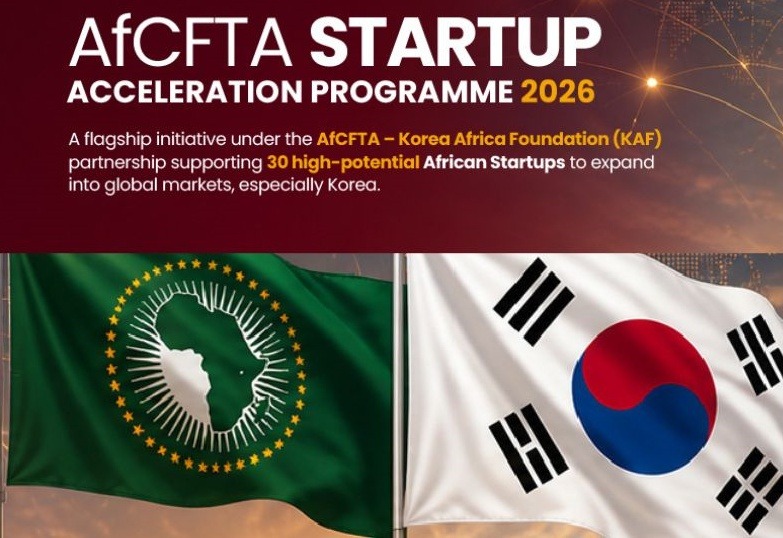
The African Continental Free Trade Area Secretariat has opened applications for a new round of its Startup Acceleration and Partnership Programme, this time anchored by a collaboration with the Korea Africa Foundation. The initiative targets African startups operating in sectors central to the continent’s economic integration agenda, with a deadline set for May 24, 2026.
What the Programme Offers
The 2026 edition goes beyond the typical acceleration template. Selected startups stand to gain structured capacity-building support, exposure to Korean and broader international markets, and introductions to investors and cross-border partners. The programme is explicitly framed around helping ventures move from local operation toward genuine international competitiveness — a challenge that continues to limit the growth of many otherwise capable African startups.
Priority sectors under the programme align with AfCFTA’s broader industrialisation and trade agenda: fintech, e-commerce, logistics, agri-tech, manufacturing, and digital platforms. These are not arbitrary choices — they represent the productive sectors where intra-African trade volumes remain well below their potential, and where private sector innovation can accelerate integration in practical terms.
Who Qualifies
The programme is open to African startups with scalable, innovation-driven business models that can demonstrate a credible path to international expansion. Applicants must also show genuine interest in entering the Korean market alongside other global opportunities. The Korea Africa Foundation’s involvement appears to make that market access pathway more than a talking point; it provides institutional backing for the corridor.
There is no indication of stage restrictions in the published guidelines, though the emphasis on “readiness for international expansion” suggests the programme is better suited to startups that have moved past early validation and can demonstrate traction.
The AfCFTA Dimension
The programme sits within AfCFTA’s broader mandate to build a unified African market, and the Secretariat’s direct involvement adds institutional weight that distinguishes it from generic acceleration initiatives. For startups in markets like Nigeria — where the sheer scale of the domestic market can make founders reluctant to look outward — the programme offers a structured incentive to think continentally and globally from an earlier stage.
Nigeria’s startup ecosystem, one of the most active on the continent, has produced companies operating across fintech, logistics, and agri-tech that could credibly apply. The same is true of hubs in Kenya, Ghana, and South Africa, where startups in these sectors have already begun exploring cross-border growth.
How to Apply
Applications are to be submitted by email to [email protected] before the May 24 deadline, accompanied by a completed application form, a business plan, and supporting documentation as outlined in the programme guidelines. The official AfCFTA programme page carries the full details.
The programme does not appear to offer direct equity investment, distinguishing it from instruments like the Afreximbank Accelerator Programme, which provides selected startups with up to $250,000 in equity funding. The AfCFTA initiative is built more around partnership architecture and market access than capital injection — a different kind of value proposition, but one that could prove more useful for startups that already have funding but lack the networks and institutional backing to cross borders effectively.