

DTH-Lab Opens Applications for 2026 Digital Health Research Fellowship

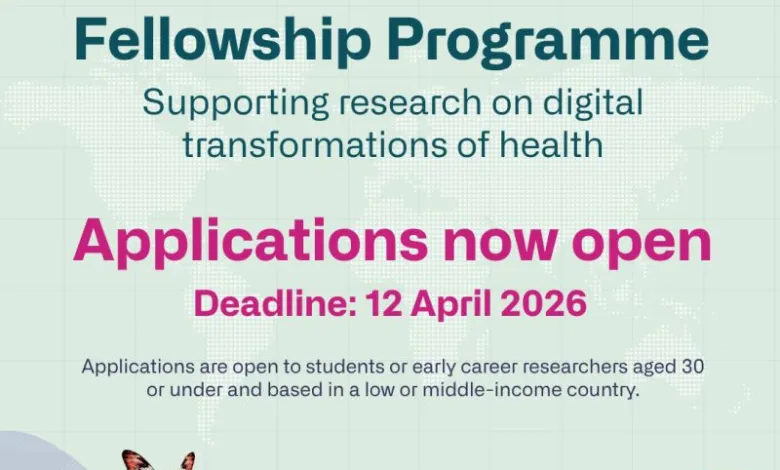
A global research fellowship programme focused on digital health and young people is accepting applications for its 2026 cohort, with a deadline of 12 April. The Digital Transformations for Health Lab (DTH-Lab) is looking for eight researchers from low and middle-income countries — and given the track record of its previous cohorts, the opportunity is one that early-career professionals across Africa should consider seriously.
What the Fellowship Involves
DTH-Lab’s Fellowship Programme offers students and early career professionals from low and middle-income countries opportunities to support a specific area of the lab’s research or analysis, with an important aim of building the capacity of future health leaders to shape policy and governance issues related to the digital transformations of health.
The 2026 cycle covers eight research areas: national policies for young people’s digital wellbeing, mapping national digital health services for young people, digital citizenship for health, AI competencies and the health workforce, and the emerging roles taking shape in an AI-enabled health system. The fellowship runs for six months, from 1 May to 31 October 2026, and is open to students or early career researchers aged 30 or under who are based in a low or middle-income country.
Why the Work Matters
DTH-Lab grew out of the Lancet and Financial Times Commission on Governing Health Futures 2030, which examined how digital transformation is reshaping health systems — particularly for young people in lower-income contexts. The fellowship programme is one of the lab’s core mechanisms for generating Southern-led evidence on these questions.
The 2025 cohort — which included researchers from Nigeria, Uganda, Kenya, Burkina Faso, and other countries — produced work that illustrates the programme’s scope. Oluwapelumi Solagbade, a medical student at Obafemi Awolowo University in Nigeria, conducted a systematic review of 36 guidelines on healthy digital technology use by children and adolescents, finding significant variation in how countries define and approach the issue. Esther Opone, a Nigerian digital health product manager, examined how African-based technology companies’ policies affect the health and wellbeing of young users on the continent. Helen Adesoba, a Nigerian public health researcher and health economist, produced a dedicated report on the trajectory of digital-first health systems in Nigeria, with a focus on adolescents and young adults.
Clare Kahuma Allelua from Uganda contributed research on data solidarity and antimicrobial stewardship. Faith Murage, a Kenyan doctor and health journalist, updated the field’s understanding of digital childhood profiles in light of new evidence. Taken together, the 2025 outputs represent a substantial body of regionally grounded work on questions that directly affect how African health systems engage with digital technology.
Who Should Apply
The fellowship is structured for researchers who want to engage directly with policy-relevant questions, not just publish. Past fellows have presented findings at international events, contributed to DTH-Lab publications, and fed their work into global governance discussions.
Interested candidates can request further background information on DTH-Lab and its existing work by writing to team[at]dthlab.org. Applications require a CV including date of birth and nationality, and details of two referees. The deadline is 23:59 CET on Sunday, 12 April 2026, with interviews scheduled for the week of 20 April. DTH-Lab welcomes applications from individuals of all backgrounds.
The full terms of reference and the application form are available on the DTH-Lab website. Researchers can also review the outputs of the 2025 cohort at the DTH-Lab Research Fellows page to get a clearer sense of the scope and nature of the work expected.
Africa’s digital health landscape is developing rapidly, but the research infrastructure that should be informing it — particularly work produced by African researchers on African realities — remains thin. Fellowships of this kind are one practical way to begin closing that gap.





This will be a good opportunity for me to take part and I am very excited to be part. I am a young social sciences researcher in a Clinical Research Unit of Nanoro where I work with local community groups about malaria.