

From a Muddy Street in Aba to Building Nigeria’s First Homegrown Phone: The Magnus Emenuga Story


Long before Magnus Emenuga ever touched a circuit board, he was already an engineer, but he just didn’t know it yet.
On Mbagwu Street, off Omuma Road in Aba, where the road was sand and mud instead of tarred concrete, weekends meant one thing: every child on the street came outside to build something. Toy cars moulded from clay. Axles cut from cassava stems. Wheels were improvised from whatever the neighbourhood considered rubbish. Nobody was teaching product design. There was no equipment, no budget, no blueprint, just a group of children turning nothing into something because that’s what curiosity does when you let it run.
“Innovation isn’t about having the best equipment,” Magnus says now, looking back on those afternoons. “It’s about making the best use of whatever you have.”
That sentence could double as the mission statement for MEmbedded TechLab, the Aba-based engineering company he now runs, and one that has designed a homegrown mobile phone, built energy monitoring systems, and trained a growing cohort of Nigerian engineers, all while operating in a country where the nearest replacement microcontroller might be weeks away by sea freight.
The Boy Who Fixed Everything
Magnus didn’t come from a technical household. His parents traded in Ariaria International Market, and engineering wasn’t a dinner-table subject. But when something broke at home, it went to his elder brother first, and Magnus was always nearby, watching, asking why, trying to understand what had failed and how to undo it. Eventually, the repair jobs started finding their way to him directly. Nobody formally taught him electronics; curiosity did.
His first real build was a torchlight that the household didn’t actually need; they already had electricity. He built it anyway, then switched off the house lights just so people could use it. “The excitement wasn’t really about the torch,” he says. “It was seeing something I created become useful to someone else. That feeling has never left me.”
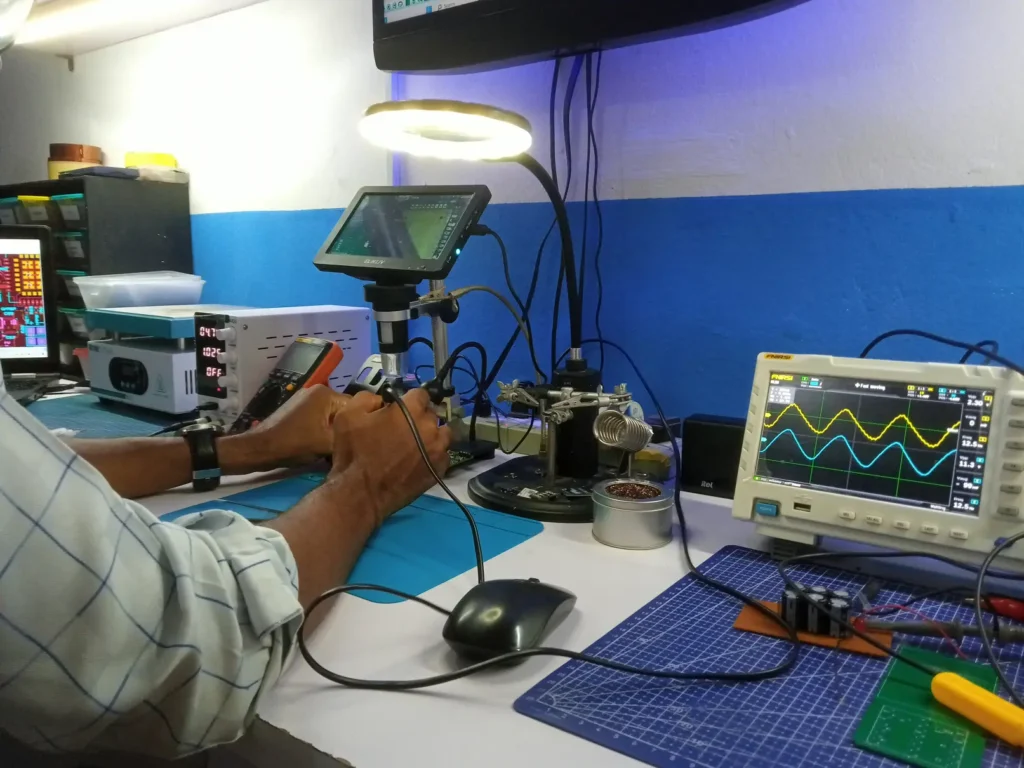
What makes the story more interesting is that engineering wasn’t even the plan. Magnus spent six years at Immaculate Conception Seminary, on track to become a Catholic priest, before leaving in 2014 to figure out an entirely different life. His first job was teaching Physics, Agricultural Science, and Geography at Christabel Achievers Summit in Aba, fresh out of secondary school himself. He later added part-time teaching at Delight Academy, supervising its JETS Club along the way.
He earned about N20,000 a month between both schools. Almost all of it went into electronic components, tools, and test instruments, while his peers spent their income elsewhere. It caught the attention of Mrs Nwose, the proprietor at Christabel, who began resourcing him to build demonstration lab equipment — voltmeters, potentiometers, ohmmeters. “She became one of the first people outside my family to invest in my curiosity,” he says.
By February 2016, he’d saved enough to rent a small shop — his first real laboratory, and the space that would eventually grow into MEmbedded TechLab.
The University That Couldn’t Keep Up
Magnus arrived at the University of Calabar in 2017, expecting formal engineering training to finally close the gap between what he knew and what he wanted to build. Instead, his first year was Mathematics, Chemistry, and Physics, which were important, but far from the circuit design and embedded systems work he was chasing. To complicate things further, he’d originally been admitted for Electronics and Computer Technology, but a reopened Faculty of Engineering redirected his set into Mechanical Engineering instead.
He responded the way you’d expect from someone who’d already been fixing things on instinct for years: he started skipping his own lectures to sit in on Year Three electronics classes instead. By his second semester, frustration had built to the point of considering dropping out entirely, but he stayed back in Aba building electronics for nearly a month before friends talked him into returning.
That near-exit changed something in him. “I realized that university could give me a degree, but becoming an engineer would ultimately be my responsibility,” he says. From then on, he split his time at Mechanical Engineering by day, self-taught electronics by night, learning from creators like ElectroBOOM, GreatScott!, Branch Education, and Lesics in the university library. “University gave me the academic foundation,” he says, “but self-learning gave me the practical engineering skills I was looking for.”
Building a Business Without Meaning To
MEmbedded TechLab wasn’t the product of a business plan. It grew out of years of quietly solving problems, a demonstration of equipment for schools, student projects, repairs, small custom jobs, one client introducing the next. Even through university, Magnus spent his holidays back in Aba, taking on electronics work and building his skill with every project.
By the time he left the University of Calabar in 2020, the side work had outgrown the label. He’d identified a real gap in Nigeria’s tech landscape: plenty of innovators with ideas, not enough technical capacity to turn those ideas into working hardware. MEmbedded TechLab was built to close that gap, taking a concept through electronics design, PCB development, embedded programming, prototyping, and testing.
The first year, by his own account, “wasn’t glamorous.” Resources were tight. What kept the pipeline of clients moving wasn’t advertising; it was documentation. Magnus posted almost everything he built on Facebook and LinkedIn: schematics, Gerber files, demo videos, the whole process laid bare. “People didn’t have to wonder what we were capable of,” he says, “because they could see the work for themselves.”
It’s a deliberate philosophy, not an accident. “I wouldn’t be where I am today if other engineers hadn’t shared their knowledge first,” he explains. Much of what he taught himself came from strangers online who owed him nothing and shared anyway. Openness has cost him — copied designs, unacknowledged reuse, but has also opened doors: partnerships, university invitations, speaking engagements, and an audience before the Governor of Abia State. “Ideas may inspire people,” he says, “but execution, consistency, and continuous learning are what truly create lasting impact.”
The Phone That Was Never Meant to Be Sold
If there’s one project that captures what MEmbedded TechLab is trying to prove, it’s the phone.
It started less as a product and more as a question that kept coming up in conversation: could Nigeria actually build a phone? Not assemble imported parts, not customize an existing device — build one, understanding every layer from hardware architecture and PCB integration to firmware, power management, and manufacturing.
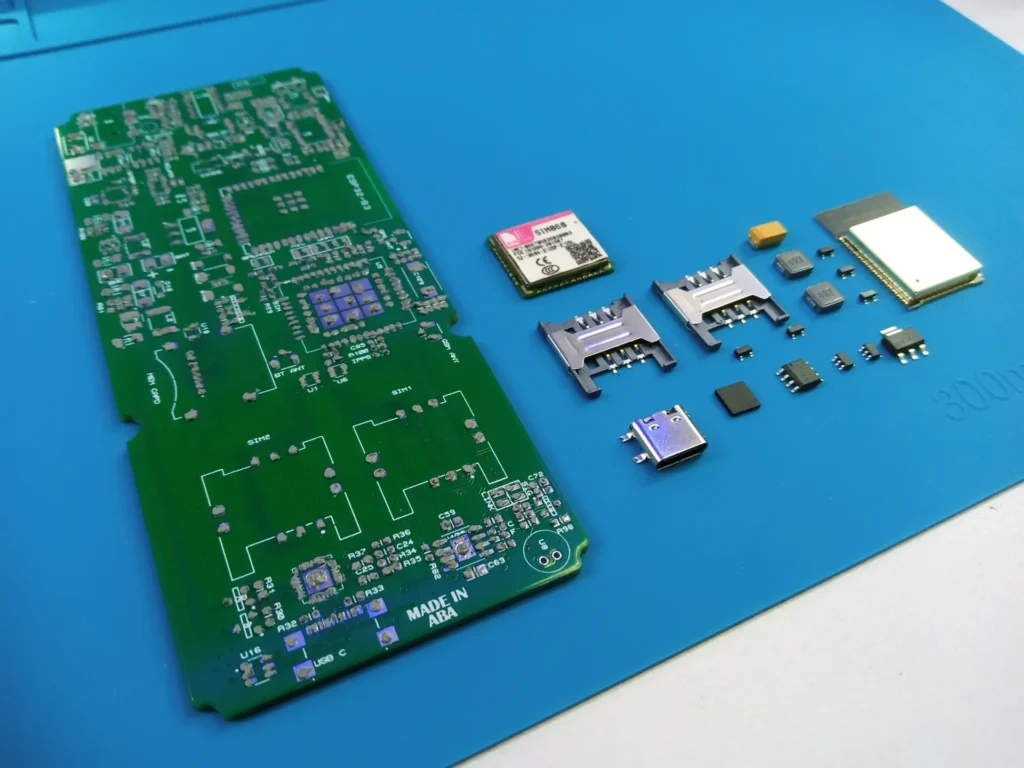
“The project wasn’t about competing with Apple or Samsung,” Magnus says. “It was about challenging ourselves as engineers.”
The hardest part, he’s quick to point out, wasn’t the software. It was making engineering decisions with limited local resources, knowing that hardware doesn’t forgive mistakes the way software does. “A mistake in software can often be fixed with an update. A mistake on a PCB usually means redesigning, waiting for fabrication, sourcing components again, and starting another test cycle.” When Magnus’s team recently presented before the Governor of Abia State, the Honourable Minister of Education, and UNDP representatives, the phone was one of the pieces they deliberately chose to showcase and proof that, in his words, “Nigerian engineers can move beyond consuming technology to understanding and creating it.”
First Principles, the Hard Way
There’s an ongoing debate in embedded systems circles about building from first principles — designing a custom operating system, understanding every layer of a stack, versus leaning on existing open platforms like AOSP to move faster. Magnus doesn’t dismiss the faster path; he just thinks too many engineers lean on it without ever understanding what’s underneath.
“Because I largely taught myself electronics, I couldn’t afford to memorize procedures. I had to understand why circuits behaved the way they did.” That habit shaped how MEmbedded TechLab approaches every project by building understanding from the ground up, even when a shortcut is available. “People often mistake that for perfectionism,” he says. “It isn’t. It’s simply about building engineers who understand technology deeply enough to create new solutions rather than only adapting existing ones. Ironically, once you understand something from first principles, you’re usually much faster when it actually matters.”
When Hardware Breaks and Teaches
Ask Magnus about failure, and he doesn’t flinch. Boards that didn’t power up. Designs that needed complete rebuilds. Components that vanished from suppliers mid-project. Products that worked perfectly on the bench and failed the moment they met real-world conditions. “Assumptions are expensive,” he says, a lesson MEmbedded TechLab now bakes into every project through rigorous testing and validation.
That humility extends to how he sees his own expertise. “The day you think you’ve mastered everything is probably the day you’ll make your biggest mistake.”
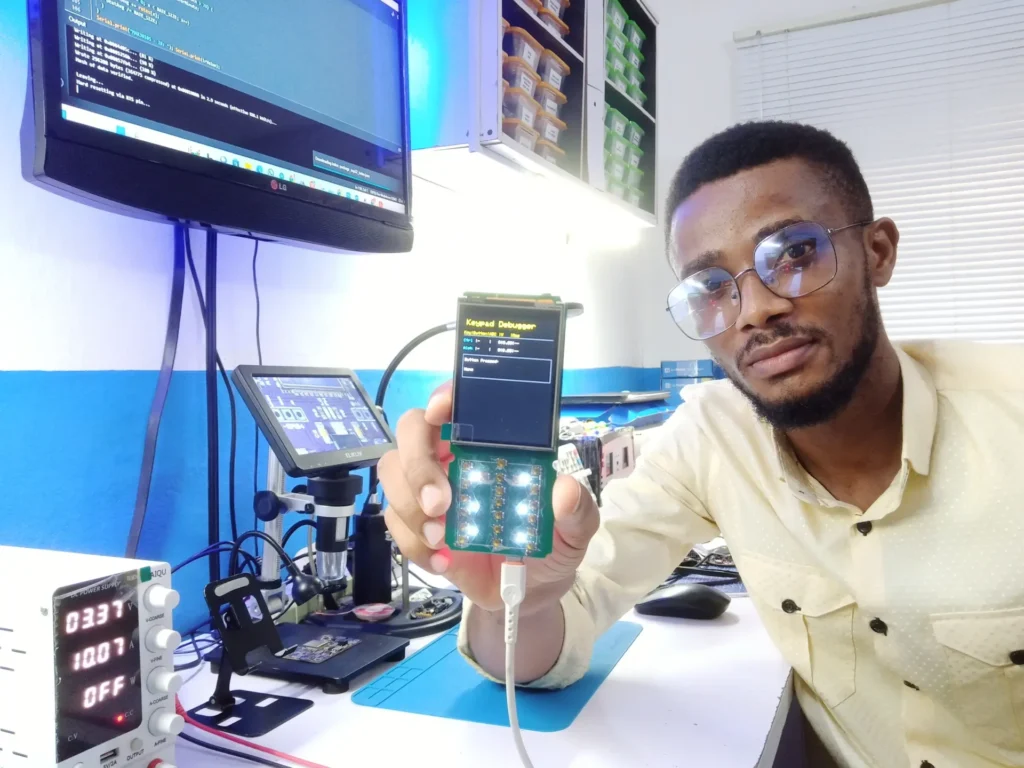
It’s a hard-won mindset, forged partly by geography. Hardware development in Nigeria means fighting a supply chain routed largely through China — a missing microcontroller, a delayed customs shipment, a supplier sending the wrong component revision, can quietly derail an entire timeline. Magnus’s team has learned to design with flexibility, qualify backup components early, and plan procurement further ahead than most people would think necessary. But he’s clear that the real fix is bigger than any one workaround: “Africa needs stronger local manufacturing and component ecosystems. It’s not simply about reducing costs. It’s about reducing dependence.”
Paying It Forward, on Purpose
Running a hardware company and training engineers at the same time isn’t the obvious business move, but for Magnus, the two were never separate missions. He got his start because Mrs. Nwose believed in an unproven teenager. After all, strangers on YouTube shared knowledge for free, because engineers worldwide published circuit designs they never expected him to see. Teaching, whether formally through programs like Innovation Growth Hub or informally through his open build logs, is how he keeps that chain going.
“Every engineer we train increases the likelihood that another innovative product will be designed in Nigeria,” he says. “If we only build products but never build people, then we’ve solved only half the problem.”
His advice to a 16-year-old version of himself that is curious, broke, or untrained is characteristically unsentimental: “Don’t wait. Don’t wait until you have a laboratory. Don’t wait until you have expensive equipment. Don’t wait until someone gives you permission. Start with whatever you have.” The barrier today, he argues, isn’t access to information. It’s consistency.
What Comes Next
Magnus talks about “technological sovereignty” not as a slogan, but as a working definition of what MEmbedded TechLab is trying to build toward, a Nigeria with the knowledge and capacity to design and manufacture critical technologies rather than simply import them. “A country that cannot design, understand, or manufacture important technologies will always depend on others to solve its problems,” he says. “That dependence affects everything, from education and healthcare to energy and national development.”
Five years from now, he hopes MEmbedded TechLab has grown into one of Africa’s leading engineering research and advanced manufacturing companies known as much for the engineers it develops as the products it ships, with technologies deployed across energy, healthcare, agriculture, education, and manufacturing. He’s optimistic about Nigeria’s ecosystem too, provided the pieces — academia, industry, government, and development partners start pulling in the same direction. “If we fail to build that ecosystem, we’ll continue consuming technologies designed elsewhere while our brightest minds search for opportunities abroad,” he warns. “But if we invest in our engineers, Nigeria can become one of Africa’s leading centres for hardware engineering and advanced manufacturing.”
It’s a long way from a muddy street in Aba, moulding toy cars out of clay. Or maybe it isn’t a long way at all, just the same instinct, scaled up: take whatever you have, and make something that works.
Connect with Magnus Emenuga and MEmbedded TechLab at membeddedtechlab.com, LinkedIn, or on his Facebook page
If you’re building a hardware idea and need a team that can take it from concept to manufacturable product, or you’re an aspiring engineer looking to learn embedded systems, MEmbedded TechLab welcomes the conversation.