
Google’s NotebookLM Adds Data Tables With Google Sheets Export

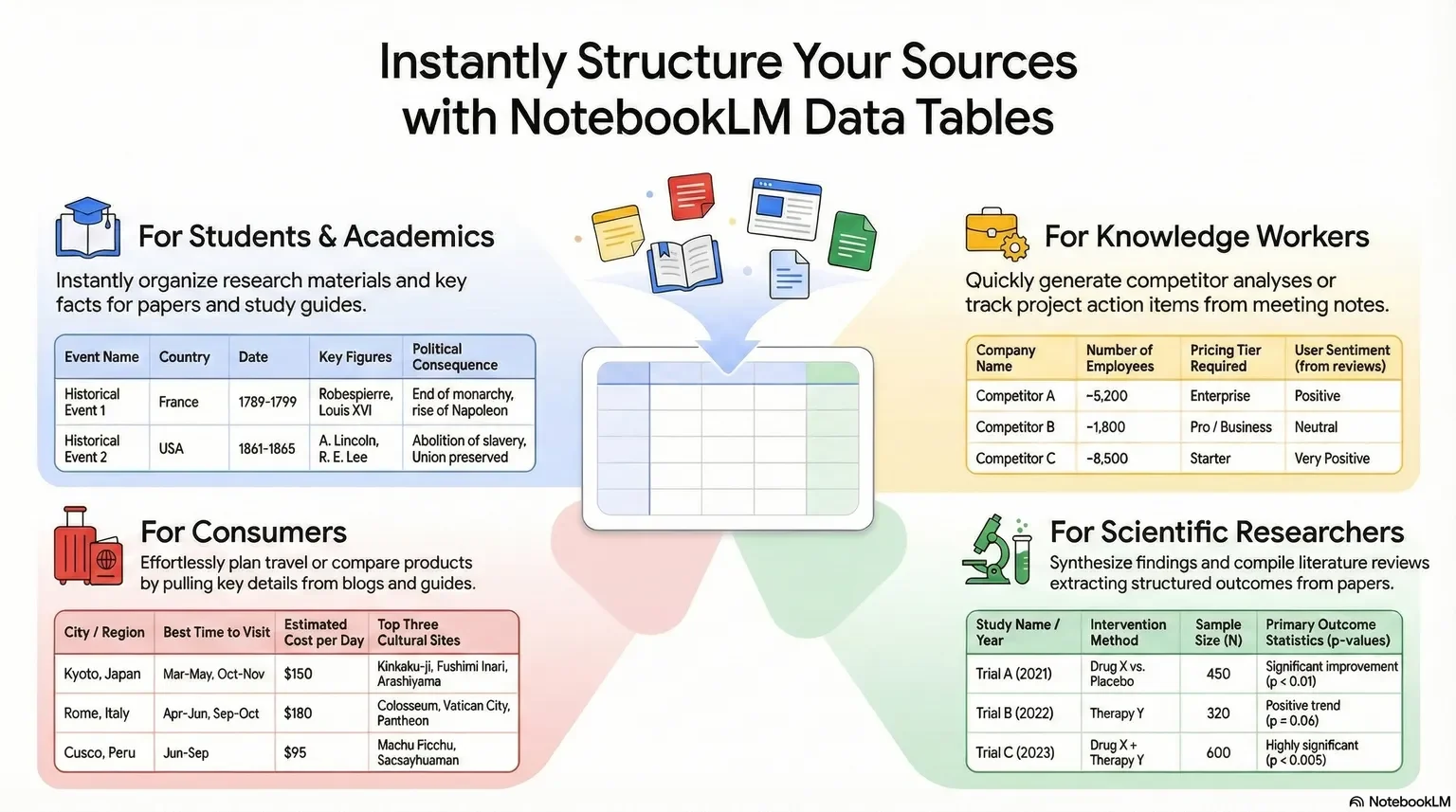
Google has introduced Data Tables to NotebookLM, its experimental AI-powered research and note-taking tool, adding a structured way to organise information extracted from user-provided sources. The update, announced through Google Labs, is designed to help users convert unstructured material into table-based formats that can be exported to Google Sheets for further analysis.
NotebookLM is primarily used to summarise and explain content drawn from documents such as PDFs, notes, transcripts, and research papers. With the addition of Data Tables, users can now ask the system to synthesise key information into rows and columns, making it easier to compare facts, track attributes, or organise findings across multiple sources.
According to Google, Data Tables can be used to organise content such as meeting transcripts, research studies, or product comparisons. For example, users might generate a table listing studies alongside publication years, sample sizes, and key results, or compare features extracted from several documents. Once created, these tables can be exported directly to Google Sheets, where users can sort, edit, and extend the data.
The rollout of Data Tables is currently limited to Google AI Pro and Google AI Ultra subscribers, with Google stating that the feature will become available to all users in the coming weeks.
In addition to Data Tables, NotebookLM also supports exporting certain AI-generated outputs, such as saved notes and reports, to formats compatible with Google Docs and Google Sheets. These export options are accessible from the Studio panel and are intended to make it easier for users to move NotebookLM-generated content into standard Google Workspace documents for review or editing.
NotebookLM has largely focused on helping users understand and interact with their own source materials through summaries and explanations. The introduction of Data Tables adds a more structured output option, which may be useful for users who need to organise information for comparison or further analysis outside the tool.
Google has not announced support for additional export formats such as native CSV or Excel files at this time. The company has positioned Data Tables as an incremental enhancement rather than a broad shift in NotebookLM’s purpose, with early access limited to paid AI subscription tiers.
As NotebookLM continues to evolve under Google Labs, features like Data Tables reflect Google’s ongoing experimentation with ways AI can assist in organising and working with user-provided information, particularly when paired with existing Google Workspace tools.