
Women-Led Agribusinesses Across Africa Have Until August 20 to Apply for AGRA-CGIAR Climate Grant

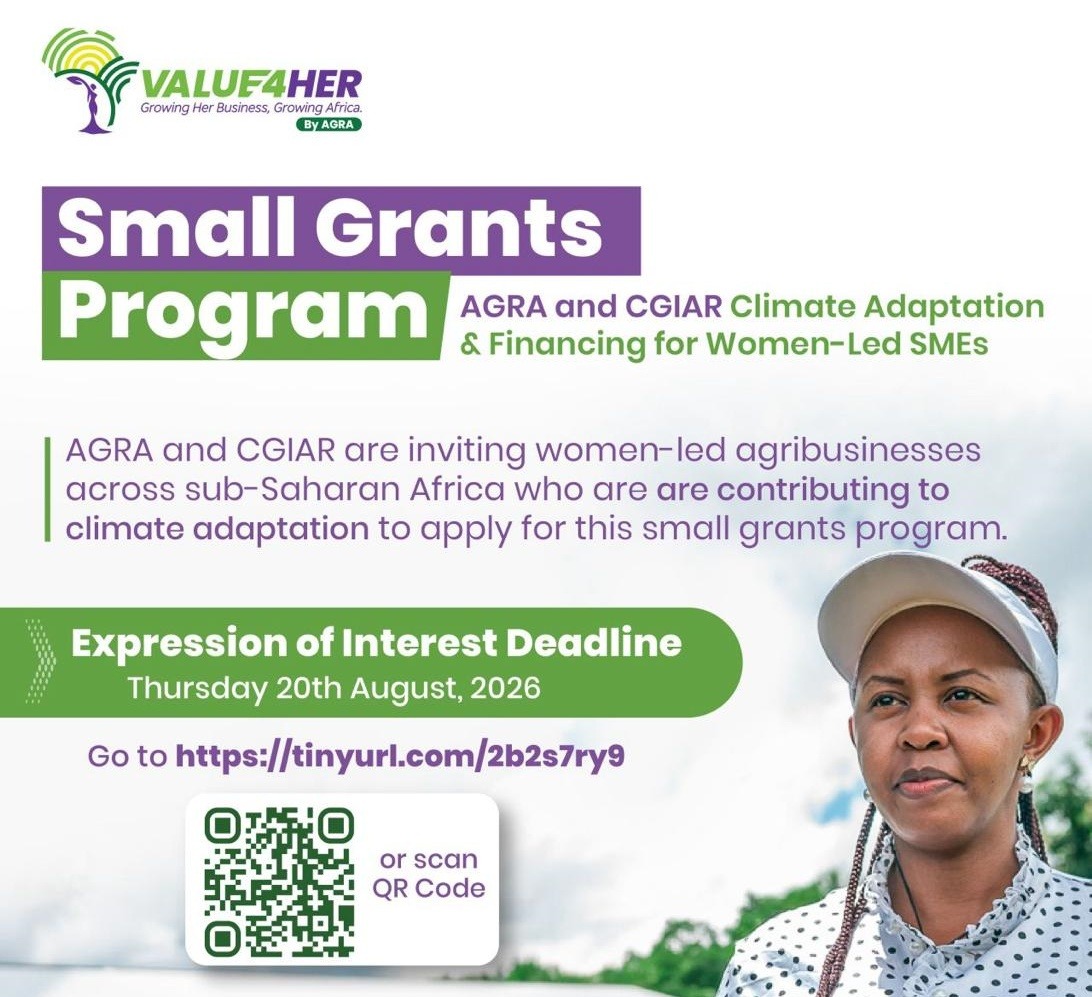
A new funding window is closing fast for women-led agribusinesses across sub-Saharan Africa working on climate adaptation, with applications for a joint AGRA and CGIAR support programme due August 20, 2026.
The initiative, delivered through AGRA’s VALUE4HER platform and CGIAR’s Adaptation Insights project, is built around a straightforward premise: women running agribusinesses that are already adapting to climate stress often lack the funding and technical backing to document, refine or scale what they are doing. This programme is designed to close that gap, however modestly, by offering small grants alongside technical assistance and capacity-building support to help selected businesses record and communicate their adaptation practices more effectively.
What the programme covers
According to details published by African Food Changemakers, which is hosting the expression of interest, selected businesses stand to receive a mix of financial and non-financial support. Beyond the grant itself, successful applicants get help building internal capacity and putting together the kind of documentation that can make their climate work legible to funders, partners and researchers — support that smaller agribusinesses rarely have the budget to commission on their own.
The eligibility bar is broad by design. Any women-led agribusiness SME operating in sub-Saharan Africa and contributing meaningfully to climate adaptation within agriculture or food systems can put in an expression of interest, though applicants are encouraged to review the official form closely, since the fine print on eligibility sits there rather than in the public listing.
Where it fits into VALUE4HER’s broader work
VALUE4HER is AGRA’s long-running effort to strengthen women-led agribusinesses across the continent by improving their access to finance, markets, skills and professional networks — gaps that have persisted despite women making up a large share of Africa’s agricultural workforce. This latest opportunity layers a climate-adaptation lens onto that existing mandate, reflecting a broader shift in how development funders are framing gender and climate work together rather than as separate tracks.
CGIAR’s involvement brings a research dimension to the partnership. The organisation’s climate work centres on strengthening the resilience of small-scale producers and developing climate-informed solutions for food systems, according to CGIAR’s own impact-area page, which lists equipping 500 million small-scale producers with adaptation tools among its stated global targets. Embedding a women-led SME grant inside that agenda gives CGIAR ground-level case studies to draw on, while giving participating businesses a level of technical credibility that can matter when they later approach commercial lenders or larger climate funds.
Why the timing matters
The kinds of businesses this programme is aimed at — those working in climate-smart agriculture, water management, resilient food processing or adaptation solutions for rural communities — are exactly the sort that tend to fall through the cracks of larger climate finance instruments, which often favour bigger tickets and more established applicants. A small grant paired with documentation support will not transform a business on its own, but it can help a woman-led SME build the track record needed to compete for larger financing later.
Interested applicants should go through the official expression-of-interest form.