
Google Overhauls Search With AI Agents, a Smarter Search Box, and Personal Context

At its annual I/O developer conference on May 19, Google unveiled what it described as the most significant transformation of its search product in decades, one that moves the platform well beyond keyword retrieval toward a system capable of acting on behalf of users, building custom tools, and learning from personal data.
The announcements, delivered through a post by Elizabeth Reid, Vice President of Search at Google, mark a deliberate acceleration of the company’s strategy to embed generative AI across every layer of how people find and interact with information online.
A Search Box Redesigned for the First Time in a Generation
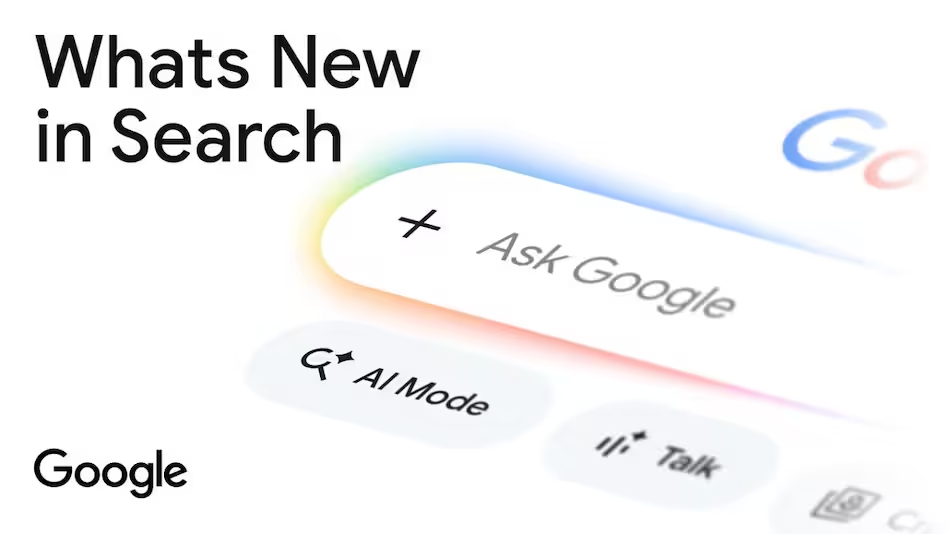
The most visible change is a complete redesign of Google’s search box the first meaningful upgrade in more than 25 years. The new interface, now powered by AI, expands dynamically as users type and offers intent-based suggestions that go beyond standard autocomplete.
More significantly, users can now submit queries across multiple formats simultaneously text, images, uploaded files, videos, and even open Chrome tabs. According to Reid, the update is rolling out globally across all countries and languages where Google’s AI Mode is currently available.
AI Agents Move Into the Search Experience
Google is also introducing what it calls “information agents” persistent, background processes that monitor the web on a user’s behalf and surface relevant updates without requiring a fresh search.
The use cases described range from tracking apartment listings against a specific set of criteria to flagging sneaker collaboration announcements from a favourite athlete. These agents are designed to synthesise results from news, social media, finance, sports, and shopping data in real time, then send users a consolidated update.
Initially, information agents will be available to Google AI Pro and Ultra subscribers, with a broader rollout expected over the summer. Agentic booking capabilities, including asking Google to call local businesses on a user’s behalf to check availability or make reservations will also expand in the United States this summer, covering categories such as home repair, beauty, and pet care.
For the millions of Africans who rely on Google Search as a primary gateway to services and information, the agentic booking feature is worth watching, even if its initial rollout is U.S.-focused. As similar infrastructure matures in markets like Nigeria and Kenya, the implications for local commerce and service discovery could be material.
Search That Writes Its Own Code
Perhaps the most technically ambitious announcement involves integrating Google’s Antigravity agentic development platform directly into Search. The result: Search can now generate custom user interfaces: tables, graphs, interactive simulations on the fly, built around the specifics of a user’s question.
Google is extending this further with the ability to build personalised “mini apps”, custom dashboards that users can return to repeatedly. The example offered was a fitness tracker built from scratch using live data including maps, weather, and user reviews. This functionality will be free for all users and available globally this summer, with some features limited to Pro and Ultra subscribers initially.
Personal Intelligence Expands to Nearly 200 Countries
Google is also widening access to its Personal Intelligence feature, which allows Search to draw on a user’s own data Gmail, Google Photos, and soon Google Calendar to contextualise results. The feature is now available in nearly 200 countries across 98 languages, with no subscription required.
Reid emphasised that users retain full control over what data is connected, and that the system was designed with transparency at its centre.
The scale of change announced at I/O 2026 reflects how seriously Google is competing to remain the default layer through which people navigate the internet a position now contested by AI-native tools that bypass search entirely. Whether the combination of agents, personalisation, and agentic coding is enough to retain that position will depend, in part, on how quickly these capabilities reach users beyond the United States.