
Bunce Founders on Turning Customer Engagement Into Revenue at Scale

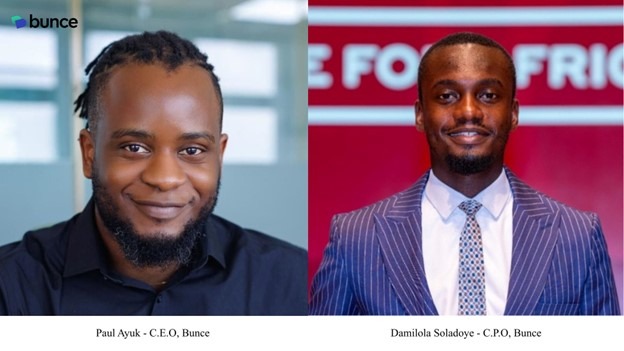
A Q&A with Paul Ayuk and Damilola Soladoye
Bunce has become known for helping businesses grow revenue through customer engagement. What problem were you actually trying to solve when you started?
Paul Ayuk:
From experience working in consumer-financing, we had seen payment recovery has a significant challenge and wanted to solve that problem. As we began building, we discovered something more fascinating. We realised that African businesses weren’t failing because they lacked customers. They were failing because they couldn’t understand them at scale. Companies had transaction data, usage data, and customer histories but lacked a practical way to turn that into action. Everything was broadcast. Nothing was intelligent.
Damilola Soladoye:
Exactly. Engagement was treated like noise. Businesses keep sending more messages, hoping something sticks. We wanted to flip that. The question we were confronted with was, “how do you speak differently to different customers, automatically, and at the right moment?”
Segmentation and customer analysis are central to Bunce. Why did you lean so heavily into those?
Paul Ayuk:
We do, because growth decisions are segmentation decisions, whether businesses realise it or not. All customers are not the same, instead they can be grouped into specific buckets based on their attributes and actions. If you treat your most valuable customer the same way you treat someone about to churn, you lose both. For instance, aggressively marketing an active user isn’t necessary but that effort may salvage a user whose engagement with your product is on the decline. We focused on behavioural segmentation payment patterns, usage frequency, lifecycle stage because that’s where truth lives. 10x improvement in customer satisfaction is the natural consequence of this kind of targeting.
Damilola Soladoye:
Once businesses saw their customers as groups with distinct behaviours, everything changed. Engagement stopped being generic. It became strategic.
You mentioned 10× improvement in customer satisfaction. What does that actually mean in practice?
Damilola Soladoye:
It shows up in response rates, retention, repeat usage, and fewer escalations. Customers respond faster. They complain less. They stay longer. When you send messages that reflect what’s actually happening in their journey, customers feel understood.
Paul Ayuk:
And satisfaction isn’t a soft metric. When customer satisfaction improves at that scale, revenue follows. Churn drops. Lifetime value increases. That’s what our customers see.
Bunce works with large, high-growth companies. How did clients like Burger King, Middleman and GIG Mobility come into the picture?
Paul Ayuk:
For companies like Burger King, Middleman or GIG Mobility, even small engagement improvements have massive financial impact. They process huge volumes. A few percentage points in retention or recovery can mean millions in revenue.
Damilola Soladoye:
These teams weren’t looking for more dashboards. They wanted outcomes. Bunce helped them identify which customers mattered most in each moment and engage them intelligently across payments, onboarding, service updates, and recovery.
Beyond tradetech and logistics, Bunce also works with financial institutions. What’s the value proposition(VP) there?
Paul Ayuk:
The primary VP is trust. Institutions like Baobab and Vale Finance operate in trust-heavy environments. Clear, timely communication directly affects repayment, loyalty, and brand credibility.
Damilola Soladoye:
When engagement is contextual based on behaviour, not assumptions, customers are far more likely to cooperate and stay engaged. Bunce is helping these organisations build that credibility with customers in a highly regulated and competitive industry.
Bunce is often described as “quietly powerful.” Is that intentional?
Damilola Soladoye:
We’re intentionally not building a loud consumer brand. We’re building infrastructure. When Bunce works well, it disappears into a business’s operations and revenue improves.
Paul Ayuk:
Our best compliment is when a customer says, “We can’t imagine operating without this now.”
What do you regard as the critical area of operation that has contributed the most to Bunce’s execution thus far?
Paul Ayuk:
Obviously, where Bunce is today is the outcome of great team work by incredible professionals supplying great expertise across functions. However, a lot of our success comes down to product ingenuity and discipline.
Damilola Soladoye:
Absolutely. John Awodeyi, our Product Manager, played a defining role. He led our work on the development of segmentation which has led to significant commercial impact for our business. More than half of our high value clients such as Zikora and Nairabet started using Bunce and have remained consistent because of our segmentation feature.
Paul Ayuk:
I agree with Damilola on the contribution of John in the area of product leadership that has enabled us as a company to innovate for our customers with testimonies of significant revenue growth. That thinking is why Bunce feels intuitive even though it’s doing something complex underneath.
Many platforms claim to be “AI-powered.” What actually differentiates Bunce’s engagement logic?
Damilola Soladoye:
We focus on relevance over buzzwords. Our engagement logic connects customer analysis directly to triggers so that messages are sent because something happened, not because a schedule says so.
Paul Ayuk:
It’s not about sending more messages. It’s about sending the right message, at the right time, to the right customer and helping businesses do so in the shortest possible time.
What impact metrics matter most to you internally?
Paul Ayuk:
Revenue uplift, churn reduction, engagement response rates, and how quickly teams can act on insights. If a customer can identify a problem and respond in minutes instead of days, we’ve done our job.
Damilola Soladoye:
We also track how deeply Bunce becomes embedded in operations. When it moves from “tool” to “system,” its impact compounds.
Looking ahead, how big can Bunce become?
Paul Ayuk:
Africa’s digital economy is scaling fast, but engagement infrastructure hasn’t caught up. Every growing business will need a system that understands customers at scale. That’s the opportunity.
Damilola Soladoye:
We see Bunce becoming the revenue intelligence layer for African businesses across fintech, logistics, marketplaces, and financial services.
If you had to summarise Bunce’s impact in one sentence, what would it be?
Paul Ayuk:
We help businesses stop guessing about their customers and start growing with certainty.
Damilola Soladoye:
We turn customer understanding into revenue.