

ZTA Drives Cybersecurity As a Growth Lever, Not Just a Cost Centre – Samuel Edet


Article written by Samuel Edet, Business Growth Analyst
Recently, cybersecurity has become about fostering trust, accelerating innovation, and driving long-term growth rather than just stopping attacks. That is made possible by Zero-Trust Architecture (ZTA).
Cyber risk has become more than a technical problem, especially as our world is becoming more hyper-connected; it is now a business issue as well. All transactions, collaborations, and customer relations depend greatly on internet trust.
The Global Risks Report (2024) by the World Economic Forum ranks cyberattacks as one of the top five threats to businesses globally. Amid this, more executives are starting to view robust cybersecurity as a strategic benefit, and not just a regulatory burden.
From startup fintechs to major international supply-chain players, corporations recognise that trust drives growth. This is strengthened by the fact that when customers and partners are assured that data and systems are secure, they engage more confidently. Zero-Trust Architecture (ZTA) strengthens this assurance: it views cybersecurity as a business facilitator, with every interaction identified, secured, and recorded.
What Is Zero-Trust Architecture (ZTA)?
Zero-Trust has a single, simple rule, which is to “never trust, and always verify”. Conventional perimeter-based security models assume the trust within the network; however, ZTA verifies identity, context, and the integrity of a device, and only after that is access granted.

Zero-Trust is based on several elements as described in the NIST SP 800-207 framework :
- Strict verification of the identities of users and devices.
- Least privilege access, which provides the user with only what he or she requires.
- Micro-segmentation in order to isolate assets and restrict the effect of breaches.
- Continuous surveillance and adaptive policy implementation.
The modern implementations leverage cloud services, threat analytics (driven by AI), and automated identity management, making ZT scalable and efficient. In the case of SMEs, the managed cloud security tools have low points of entry that were previously restricted to large organisations.
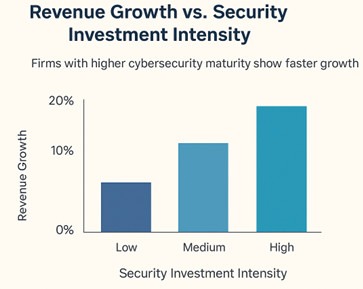
From Risk Mitigation to Growth Enablement
The misconception about cybersecurity being a drain on resources is quickly disappearing. Zero-Trust is a ‘digital era development’ that is directly related to business growth, with its impact measurable in the following ways:
- Accelerated Partners and Customer Trust.
Businesses increasingly seek secure-by-design partners for major agreements and contracts would sign contracts. An organisation that has an established and verifiable ZT structure can expedite business approvals and alliances with vendors. IBM Cost of a Data Breach Report 2024 states that fully implemented Zero-Trust results in organisations saving an average of 1.5 million dollars on a single breach as compared to those that do not. The additional capital could be reinvested in innovation.
- Operational Resilience
Attacks that decrease downtimes are minimised by real-time verification and micro-segmentation. In the event of an attack, it is rapidly contained, preventing disruption of customer experience and revenue. This strength silently pushes towards growth: the fewer there are disruptions, the more regular the service and the greater the retention.
3) Regulatory Benefit and Opening the Market.
Adherence to laws, including GDPR (EU), the NDPR (Nigeria), or the U.S. CCPA, is easier in a Zero-Trust framework. Compliance opens up markets where the credibility of data protection is a precondition. According to a 2022 McKinsey Digital Trust Survey of 1,300 business leaders and 3000 consumers globally, organizations that are best positioned to build digital trust are also more likely than others to see annual growth rates of at least 10 per cent on their top and bottom lines.

Challenges and Misconceptions
The adoption of zero-trust is still experiencing some practical challenges:
Perceived cost and complexity: A significant number of SMEs believe that having ZT will mean having a complete overhaul of their infrastructure. As a matter of fact, cloud-native solutions such as Microsoft Entra ID, Okta, and AWS IAM enable modular and scalable deployments.
Cultural resistance: New access controls can be viewed as obstacles rather than safeguards by some employees. The business leadership must communicate the importance of security in the facilitation of business performance, and not just as an IT upgrade.
Skill gaps: Zero-Trust migration requires cross-functional co-operation between IT, risk management, and business-strategy teams. Companies that invest in in-house training or collaborate with outsourced security firms have higher chances of gaining long-term advantages.
An Analyst’s Suggestion On A Growth-Oriented Strategy for ZT
As a growth analyst, I see ZT from a perspective of ROI and strategic alignment. ZT implementation should not begin with firewalls; rather, it should begin with business priorities. The following are brief action plans to redesign cybersecurity as a growth driver:
- Assess/Evaluate: Map important revenue-related data flows. Determine those systems where trust failure would stop growth (generally known as crown-jewel systems)
- Align: Establish and integrate cybersecurity metrics (uptime, partner readiness, customer trust index) in line with growth KPIs.
- Integrate: Incorporate identity verification and policy automation into the day-to-day operations.
- Automate: Continuous monitoring and predicting the risk by using AI-driven analytics.
- Measure: Track “trust-ROI,” which includes lowered breach cost, shorter deal closures, and increased retention.
This alignment will give rise to each cybersecurity investment contributing to the final business growth results, the enhanced resiliency, scalability, and confidence of the stakeholders.

Trust is the New Currency of Growth.
Cybersecurity is not sitting in the cost column anymore, but is at the core of value creation. Zero-Trust Architecture (ZTA) redefines the concept of digital protection as a digital potential. Companies that embrace ZTA do not merely “secure data or information”; they establish trust, responsiveness, and a competitive edge.
With the changing cyber threats and growing customer demands of being transparent, trust itself emerges as a quantifiable growth indicator. The fast-growing businesses in the new economy will be the ones that are most trusted, and Zero-Trust is the currency that visionary businesses will print.
Samuel Francis Edet is a proficient AI and data analyst; passionate about helping businesses use technology more intelligently to achieve growth while staying responsible and sustainable.