
WhatsApp Announces Enhanced Account Security Against Sophisticated Cyberattacks

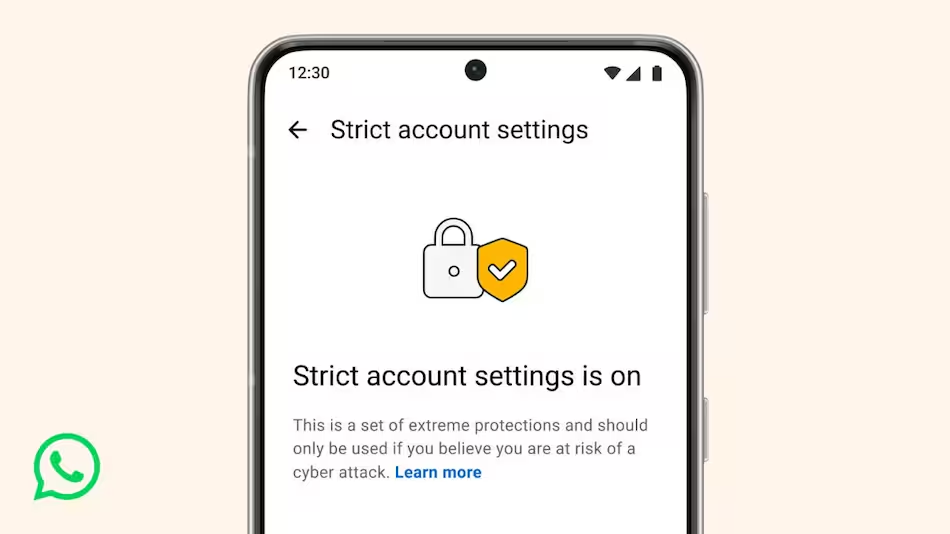
WhatsApp unveiled on Tuesday a new security solution aimed at protecting vulnerable users from sophisticated cyberattacks. Strict Account Settings is a function that claims to lock the targeted user’s account to the most restricted setting possible, prohibiting attachments and other media received from people who are not on their contact list. The Meta-owned instant messaging company claims its new security feature will be rolled out to all users in the coming weeks.
Strict WhatsApp Account Settings
The new Strict Account Settings feature, according to WhatsApp’s blog post, is intended for public personalities like journalists who are particularly vulnerable to cyberattacks. In essence, it limits the capabilities of the instant messaging service by putting the WhatsApp account in lockdown mode.
To activate the function, launch WhatsApp on your phone and select Settings > Privacy > Advanced.
Strict Account Settings are allegedly a component of WhatsApp’s most recent effort to protect vulnerable users from spyware and assaults. The Meta-owned app also adopted Rust, a programming language, to help achieve its goals by safeguarding messages, videos, and images from possible security flaws.
The business claims that wamedia, WhatsApp’s cross-platform C++ library for sending and consistently formatting MP4 files, was created concurrently with Rust, a memory-safe language. Differential fuzzing, rigorous integration, and unit testing were employed to guarantee compatibility between the two implementations.
The IT firm is said to have demonstrated performance and runtime memory consumption gains over C++ by substituting 90,000 lines of Rust code for 160,000 lines of C++ code. According to reports, its launch made it possible for WhatsApp to create a high-performance, secure cross-platform library that guarantees media shared on the site is safe and consistent across devices.
WhatsApp has also implemented safeguards like CFI, tougher memory allocators, safer buffer handling APIs, and more in recent years. In addition, developers have access to development guidelines, specialized training, and automatic security analyses of their modifications. Finally, it is reported that WhatsApp uses stringent SLAs to address problems found during the risk discovery process.