

OpenAI Launches Enterprise Platform, Frontier as Competition for Business Clients Intensifies

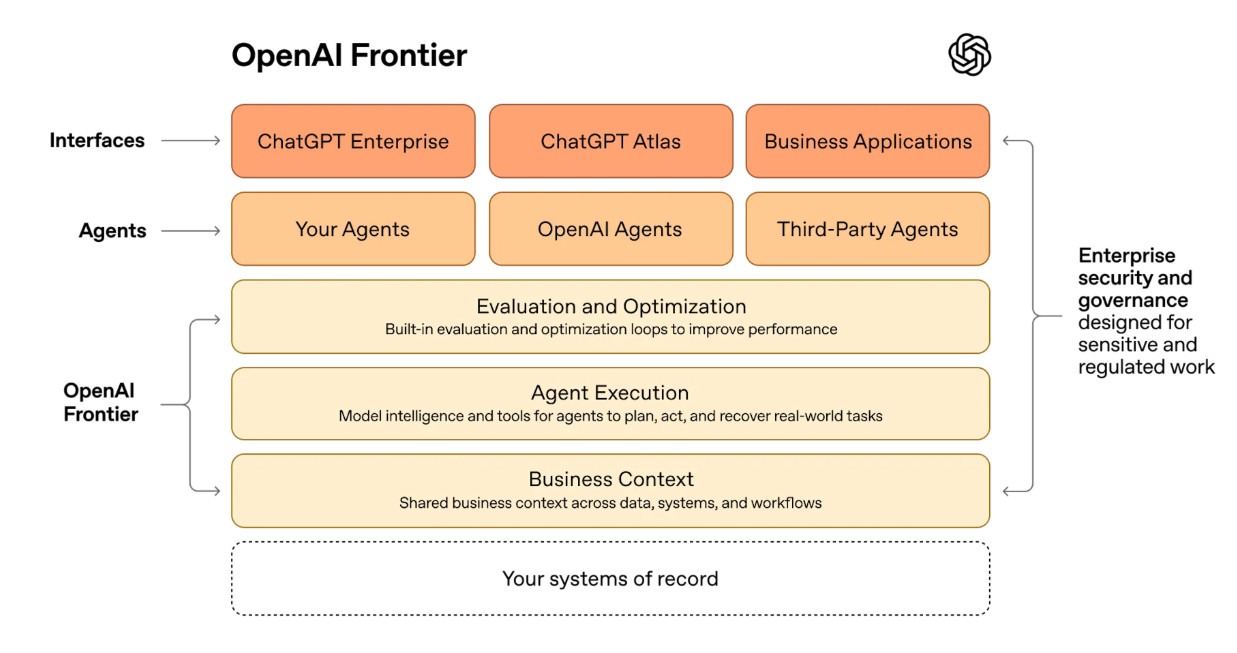
OpenAI has introduced a new enterprise platform designed to help organizations deploy and manage artificial intelligence agents across their operations, marking the company’s most aggressive move yet into the corporate software market.
The platform, called Frontier, was announced on February 5, 2026, and represents a strategic shift for the San Francisco-based company as it seeks to expand its presence among business customers. According to company executives, the system functions as an intelligence layer that connects disparate enterprise systems, allowing AI agents to operate across databases, customer relationship management tools, and internal applications.
Strategic Push Into Enterprise Market
Fidji Simo, who serves as OpenAI’s chief executive officer of applications, described Frontier as a recognition that the company cannot build everything on its own. The platform enables organizations to integrate AI agents from multiple providers, including competitors such as Google, Microsoft, and Anthropic.
The timing of the launch reflects OpenAI’s intensifying focus on corporate clients. Sarah Friar, the company’s chief financial officer, stated in January that enterprise customers currently account for approximately 40 percent of OpenAI’s business, with expectations to reach 50 percent by year-end.
OpenAI, founded in 2015, has evolved from a research organization into a commercial entity valued at hundreds of billions of dollars. The company now serves over one million businesses worldwide through its suite of AI tools, including ChatGPT Enterprise.
How the Platform Works
Frontier addresses a fundamental challenge facing enterprises attempting to deploy AI: the fragmentation of data and systems across organizations. The platform provides AI agents with what OpenAI describes as workplace skills—shared context, onboarding capabilities, feedback mechanisms, and permission structures that mirror human workflows.
Denise Dresser, OpenAI’s chief revenue officer, explained that what companies need is a straightforward method to enable agents to function as teammates within the business without requiring extensive infrastructure changes.
The system allows agents to access files, execute code, and utilize tools within an open execution environment. Built-in evaluation mechanisms are designed to help agents improve performance over time through feedback loops.
Early Adoption and Market Impact
Several major corporations have already begun working with the platform. Intuit, State Farm, Thermo Fisher Scientific, Uber, HP, and Oracle are among the initial customers, while financial services firm BBVA, networking equipment maker Cisco, and telecommunications provider T-Mobile have piloted the technology.
Joe Park, executive vice president and chief digital information officer at State Farm, indicated that combining OpenAI’s platform with the company’s workforce is accelerating their AI capabilities and creating new methods to serve millions of customers.
The launch has implications beyond OpenAI’s immediate business prospects. Traditional enterprise software providers have seen stock valuations decline amid concerns that AI-native platforms could displace established software relationships. If AI agents can execute workflows without requiring users to log into conventional applications, the value proposition of per-seat licensing models faces scrutiny.
African Enterprise Considerations
For African businesses evaluating enterprise AI deployments, the emergence of platforms like Frontier presents both opportunities and considerations. Organizations across Africa’s financial services, telecommunications, and manufacturing sectors have shown increasing interest in automation technologies that can address operational inefficiencies and expand service capabilities.
However, successful implementation requires attention to data governance, infrastructure compatibility, and workforce readiness—factors that vary significantly across African markets. The platform’s compatibility with existing enterprise systems may appeal to organizations seeking to enhance capabilities without wholesale technology replacement.
Competitive Landscape
OpenAI’s move comes amid heightened competition in the enterprise AI market. Anthropic, a rival AI company, recently launched Claude Cowork, which similarly enables deployment of AI agents across business software. According to market research from Menlo Ventures, OpenAI currently holds 27 percent of the total enterprise AI market.
The company has paired the platform launch with the availability of forward-deployed engineers who will work directly with corporate IT teams to establish agent workflows in production environments—an acknowledgment that enterprise adoption requires hands-on technical support.
Chief Executive Sam Altman has stated that companies succeeding in the future will make extensive use of AI, with people managing teams of agents to accomplish complex objectives.
OpenAI has not disclosed pricing details for Frontier. The platform will expand to broader availability over the coming months following the initial limited release to early customers.